Rajbet on Social Media: Distinguishing an Operator Statement from an Unaffiliated Fan Page
Introduction
A social media account using the Rajbet name may look authoritative, but that does not establish who controls it. A link to Rajbet may help verify an account, but a name, logo or polished post alone does not prove that a message comes from the operator.
This distinction matters when an account makes claims about policy, availability, promotions, payments or customer support. A fan page may share accurate information, add its own interpretation or circulate an old post without intending to mislead. Readers still need to know whether the account is authorised to speak for the business.
No specific social account or post is identified here as official or unaffiliated. The responsible approach is not to judge ownership by appearance, but to consider the evidence and acknowledge uncertainty when it is incomplete.
Analysis of the accounts
Sports coverage often uses familiar visual cues—a club crest, a player photograph or a branded backdrop. These help audiences recognise the subject, but not the publisher. The same applies to a Rajbet-branded account: its name or graphics show what the page is about, not who runs it.
An operator statement comes from the business itself or from a person or account it has clearly authorised. A fan page is independently controlled, even if its posts are accurate, well researched or supportive. Some accounts fall between these categories: aggregators, community pages, affiliates and partners may have a relationship with the operator that is not clear from their profiles.
That ambiguity makes it easy to reach a conclusion too quickly. An account might have permission to repost selected material without being authorised to announce policy changes. An employee might also share personal views that do not represent the company. An account’s relationship with the operator and the scope of its authority are separate questions.
A verified badge is not a complete answer either. It may mean that the platform has confirmed an account under its current rules, but badges vary in meaning and do not necessarily show that every post is an approved company statement. Likewise, an account without a badge is not automatically unaffiliated.
Key factors
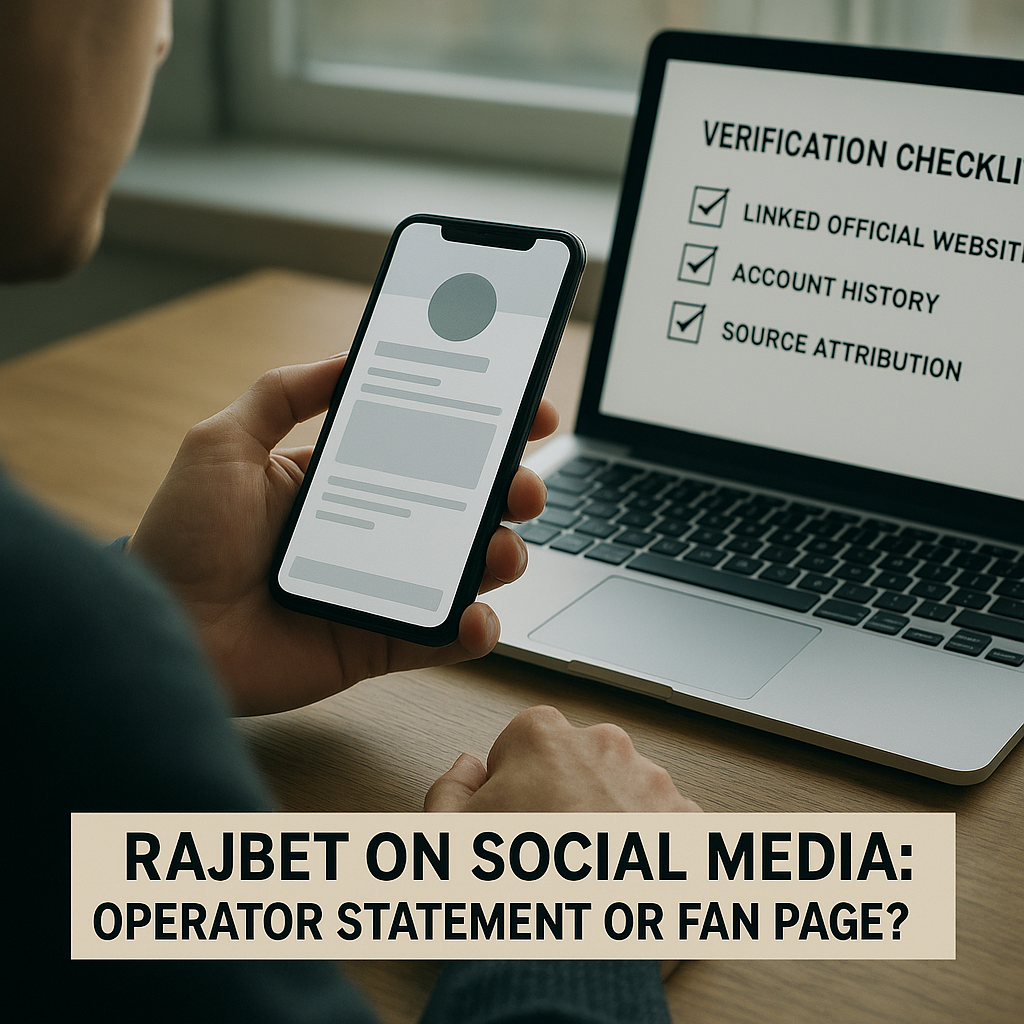
A strong starting point is a direct link from a source controlled by the business. If the official website identifies a social profile and that profile links back to the same website, the two-way connection is meaningful evidence. A link from the profile alone is weaker: anyone can add a web address to a bio.
Look for specific confirmation, not just repetition. A corporate contact page, legal disclosure or published directory that names the account is more useful than several profiles repeating the same handle. Reposts can create an echo chamber in which multiple pages appear to confirm one another but rely on a single unverified source.
An account’s history can provide context. A long, consistent record of posts, transparent corrections and links to primary sources is more persuasive than a recently created page making high-stakes claims. But age does not prove ownership: an old fan page remains unaffiliated unless its authority is established.
Pay attention to the post’s wording as well as the profile. Does it identify the speaker and distinguish an official update from commentary? Does it link to a primary statement, or ask readers to rely on screenshots and urgency? A confident tone and professional design are not proof. Nor does awkward wording, by itself, prove impersonation.
Timing and context matter. A cropped screenshot may hide the account name, date or replies showing that the material was quoted, corrected or challenged. Before attributing a statement, compare the full post with any related notice on a controlled website or another independently confirmed channel. If you cannot find the material at its source, describe it as an unverified claim, not an operator announcement.
The stakes should determine how much verification is needed. A general fan reaction does not require the same scrutiny as a claim about account access, financial arrangements, eligibility or changes to terms. The more consequential the message, the less reasonable it is to infer authority from a logo or viral repost. If a claim could affect readers’ decisions, make the attribution explicit and keep any uncertainty visible.
Authenticity and accuracy are also separate questions. An account may genuinely belong to an operator and still publish a mistake, while an unaffiliated fan page may share correct information. Verification tells you who controls the channel; it does not establish whether a particular statement is true, current or complete. Both need to be checked.
Scenario: how to read a disputed post
Imagine a Rajbet-branded page posts a short notice about a service change. The branding looks familiar, but the post has no clear source and several accounts are sharing it. The responsible first step is to avoid calling it an official announcement until the publisher’s authority can be confirmed.
Compare the post with primary channels independently linked to the business. Check whether the notice appears in a formal update, whether a controlled source identifies the social profile, and whether the date and wording match. A link from the page to a website is not enough; look for confirmation in the other direction as well.
If these checks provide no confirmation, that does not mean the account is fraudulent. Its status is simply unverified. This is fairer to the account holder and safer for readers than treating a lack of proof as an accusation—or a familiar brand as proof of authority.
Conclusion
Follower counts, polished visuals and confident language do not distinguish an operator statement from an unaffiliated fan page. The distinction depends on evidence of control and authorisation: identification by a reliable source, reciprocal links, consistent disclosures and a post whose origin can be checked.
Even then, confirming who is speaking does not prove every claim they make. Ask two questions: who is speaking, and what supports the statement? If the first answer is uncertain, say so: a Rajbet-branded social account made the claim, but its status as an operator statement has not been established.